Semper tiro

You have to resist the little things that pain you

or worry you, 

that tempt, and say, 

You know you want to stress about this, 

that there’s fear to be played out, 

imagined,

(that is, to let your fear imagine what happens, 

not you). 

My stomach tightens at the thought of going out tonight (or any night). Even determining the time: 

do you have a time you want to go?

6, I say. 

How about 5:45?

That’s good. 

Leave at 5:45? D breaks in. 

Uh. 

And then T:

Could we do 6:15?

Easier for M. 

Well, 

that’s that. 

Little things. Stress. Choosing to go with it, 

to try to find a place in me 

perfectly willing to accept what’s settled, 

even to be not only fine with it, 

but good with it, 

(on good terms, 

ready, 

content).

And so on. 

Quiconque est simple, qu’il vienne à moi

« Non mais

ce que vous appelez 

la douceur,

qui est un mot

qui revient souvent

de mes proches

ou même des gens

qui me lisent

et parfois des journalistes

et des critiques,

c’est que

je pense que

les plus grands drames 

sont dans les silences,

dans les attentes,

mais aussi

la résolution

des plus grands drames

est dans les silences

et les attentes. »

*

[No but

what you call

sweetness,

which is a word

that comes up often

with my friends and family

or even from people

who read me

and sometimes journalists

and critics,

it’s that

I think that

the greatest dramas

are in the silences, 

in the waiting,

but also

the resolution

of the greatest dramas

are in the silences

and in the waiting.]

*

Voici un autre extrait de la épisode récente sur Les Lueurs avec Éric-Emmanuel Schmitt.

[Here is another extract from the recent episode on Les Lueurs with Éric-Emmanuel Schmitt.]

Ça y est

I had to start writing it, the first novel. 

It’s strange. It isn’t what I – how to put this? – wanted, or would have wanted, or expected, but it’s started, it isn’t nothing, and that is enough now for me. I intend to finish it and publish it. 

Of course (I suppose) I’ll edit it. This seems to me unimportant now. 

The point is, I’m beginning my novel. 

I’m thinking of something Gaber says in this book I got recently. 

He says something along the lines of: 

If you would know yourself, and really, write a novel, or paint a picture, create an album. Take up the work, and see it through, difficulties and all, imperfections and all. Carry it all the way to the end.

It won’t be perfect. It won’t be what you thought it would be, what you wanted or expected: it’ll be something else. But you’ll only know what it is after you’ve done it.

That’s what I mean. 

*

Bisognerebbe mettersi lì

a fare qualcosa,

scrivere una canzone,

un libro,

dipingere un quadro,

e solo dopo

chiedersi:

« Come sono?»,

non prima. 

Magari vien fuori

che sei fascista. 

Peccato,

però almeno

lo sai. 

Altrimenti 

non sai in fondo

chi sei

e non ti puoi cambiare. 

E poi 

c’è il momento 

della verifica. [Giorgo Gaber]

*

[It would be necessary to put yourself there

where you can do something,

write a song,

a book,

paint a picture,

and only after

to ask yourself:

“What am I?”,

not before.

Perhaps you find out

that you’re a fascist.

A shame, 

but at least

you know.

Otherwise

you don’t know at bottom

who you are

and you can’t change.

And then

there’s the moment

that confirms.] 

*

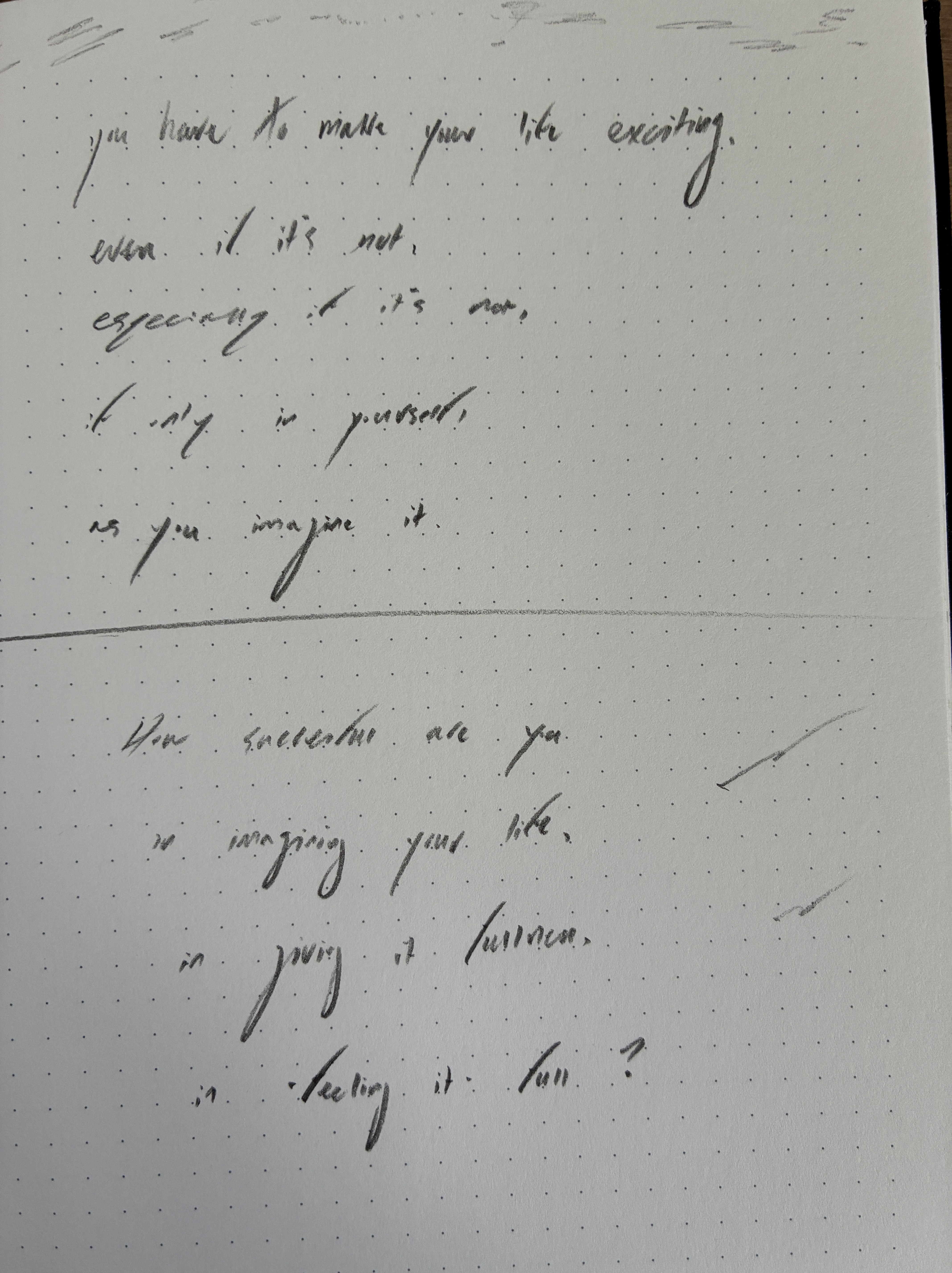
You have to make your life exciting,

even if it’s not,

especially if it’s not,

if only in yourself, 

as you imagine it. 

*

How succesful are you 

in imagining your life, 

in giving it fullness,

in feeling it full? 

*

Quand on écrit

on fait ce qu’on peut,

n’est-ce pas. 

On ne sait les choses

qu’après. 

On ne sait tout 

qu’après. 

On ne sait rien

pendant. 

On ne sait rien. [Brel]

*

[When you write

you do what you can,

isn’t it. 

You don’t what it is

till after.

You don’t know everything

till after.

You know nothing

during.

You know nothing.]

Responding to Emerson

From his journal:

Nov. 8, 1838

Let me never fall into 

the vulgar mistake

of dreaming that I am persecuted

whenever I am contradicted. 

[I, what do I do? I contradict everyone in my head. And then I contradict myself. ‘Existential solitude’?! Ha. I know no intellectuals (in the flesh), or, at least, no one (as far as I know) reading what I’m reading, thinking with the authors I’m thinking with. This is no excuse. But I… I trust myself very little. My thoughts are agitated, sensitive; if anything is sure, it’s a few feelings, the words for which I typically lack.]

No man, I think, 

had ever a greater well being

with a less desert

than I. 

[I cannot say the same. But I admire E’s confidence here.]

I can very well afford

to be accounted

bad or foolish

by a few dozen or a few hundred persons—

I who see myself greeted

by the good expectation

of so many friends

far beyond any power of thought

or communication of thought

residing in me. 

[We sense, but we don’t know. We know, but we don’t know. There is a feeling, and the essential thing is how we serve it, how responsible we are to it, in our everday lives, in our smallest acts. And, importantly, how willing we are to suffer for it, — will we remain loyal when we are most tempted to renounce, on the days and in the hours when we feel its weight the most; in our darkest moments, when it costs us the most, how do we respond to it?]

Besides, I own,

I am often inclined 

to take part with those

who say I am bad or foolish,

for I fear I am both.

[I’ll say in French: tout le monde l’est. Et ce qui importe, c’est de le savoir, et de faire des efforts pour ne pas l’être, ou plutôt de l’être moins, parce qu’on est humain.] [‘Everyone is. And what matters is knowing it, and to make efforts to not be, or rather to be so less, because we’re human.]

I believe and know

there must be 

a perfect compensation. 

[‘Nothing is got for nothing.’]

I know too well 

my own dark spots.

Not having

myself attained,

not satisfied myself,

far from a holy obedience—

how can I expect to satisfy others,

to command their love?

[‘But how can he expect that others should… for who himself will take no heed at all?’]

A few sour faces,

a few biting paragraphs—

is but a cheap expiation

for all these shortcomings of mine.

[To ‘know how to estimate a sour face’, ça vaut la peine. How many I offer up every day, and there’s nothing but a stupid haste or anxiety behind – we’re not so deep (or mean) as that! 

*

Nov. 9, 1838

I find no good lives.

I would live well. 

I seem to be free to do so,

yet I think with very little respect

of my way of living;

it is weak,

partial,

not full

and not progressive.

But I do not see any other

that suits me better. 

The scholars are shiftless

and the merchants are dull.

[As loyal as we are to our best thoughts,

the feelings that stir and move us the most,

the image of our heart,

the hints and nods of the soul,

how we treat ourselves when we’re suffering the most,

how we find our balance again,

our willingness to accept ourselves,

fumbling and grasping as we are,

awkward imperfect near-animals;

how we resist our worst thoughts,

the shallowness and evasions that come and pile on,

suffocate and overwhelm;

how we resist our inherent barbarism,

the meanness that not one of us is free from;

how we get up and go on.] 

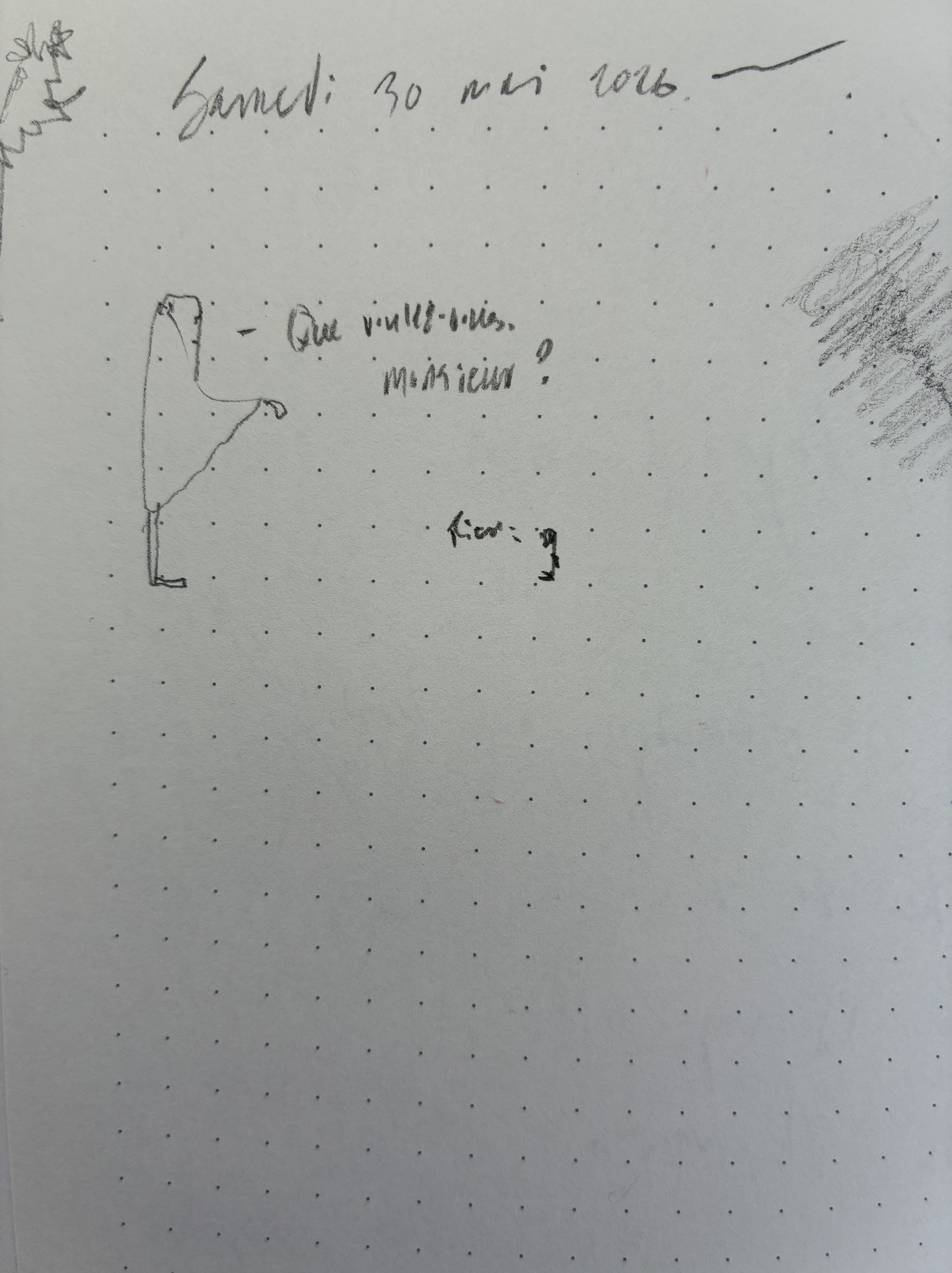
Que voulez-vous, monsieur ?

The mind tempts, provokes. A whirlwind. Left and right, every direction, it would ensnare you in some trap, some ruse. Little resentments, little offenses, little fears, one after the other, take me! take me!

Concentrated effort is obviously the antidote, a push in a certain direction, be it physical or mental. Sitting in one place, bearing the assault of one’s thoughts, is worse than useless; you’re going to lose. (I’m speaking to myself here.) 

There is the desire in me to do what I want (the entirety) all at once. Naturally this makes things difficult, because impossible. I (like everyone else, I suppose) can only go one step at a time. One page at a time, one shift at a time, one hour at a time, etc. You have to accept these limits. (Otherwise, you’re losing your mind.) 

The mind is irresponsible. It doesn’t know any limits. It is fragile and excessive. It is a circus and a funeral, heaven and hell, redemption and damnation, one merging or reverting into the other, again and again; chaos and the dark. Or, let’s say, it’s just the hint of these things. We fall through life, expecting something.

Life supposes risk. I go to work, I go to my desk, and I don’t know what’s going to happen. In ten minutes I can feel doomed to misery and on the point of bursting with joy. (More often than not, it’s not so extreme, but you know what I mean.) A lot of life happens in our head; a private show. ‘We wake from one dream into another dream’ (Emerson). 

Que tout soit mis en oubli, de ce qui est derrière moi, puisque voilà le ciel et la terre

[May everything be forgotten

of what’s behind me,

because behold the sky and the earth.]

[C.F. Ramuz, Aimé Pache peintre vaudois ; quelques traductions encore / some more translations.]

*

C’est vers ce temps qu’il écrivit dans son cahier :

« Je sens bien que je pourrai être encore malheureux,

et que je souffrirai 

et que je ne suis à l’abri de rien

de ce qui nous menace dans la vie :

pourtant tout est changé.

Chaque malheur qui viendra,

il est accepté d’avance ; 

il me trouvera à ma place,

et je le mettrai à sa place,

il ne détruira rien en moi.

Je l’envisagerai

et je lui dirai :

« Je sais d’où tu viens et ce que tu veux ;

voilà, ma porte t’est ouverte. »

Et à chaque joie qui viendra,

je dirai aussi :

« Entre librement. »

Mais moi, 

je resterai le même. 

Parce qu’il y a des certitudes. 

Il me semble que j’ai à moi

deux ou trois grandes certitudes 

auxquelles je suis pour toujours lié,

et c’est pourquoi je me sens fort.

Il y a longtemps sans doute

qu’elles étaient en moi,

ou du moins

elles n’y sont pas venues tout à coup,

mais j’ignorais qu’elles étaient là ;

et il m’a fallu bien de la peine 

pour les découvrir ;

et puis, les ayant découvertes, 

longtemps encore j’en ai douté.

Maintenant je ne doute plus.

Pointet le taupier tend ses trappes ;

moi je peins dans mon village. »

*

[It was near this time that he wrote in his notebook:

“I know well that I could still be unhappier,

and that I will suffer

and that I’m not out of reach of anything

that threatens us in life:

still, everything’s changed.

Every adversity that’ll come

I accept in advance;

it will find me in my place,

and I’ll put it in its place,

it won’t destroy anything in me. 

I’ll look at it

and I’ll tell it:

‘I know where you come from and what you want;

do as you will, my door is open.’

And to every joy that’ll come,

I’ll say too:

‘Enter freely.’

But me,

I’ll stay the same.

Because there are certitudes.

It seems to me that I have

two or three real certitudes

to which I am forever bound,

and that’s why I feel strong.

Probably they’ve been in me for a long time,

or at least

they didn’t come all of a sudden,

but I didn’t know they were there;

and it took me a lot of pain

to find them;

and then, having found them,

still for a long time I doubted.

Now I don’t doubt anymore.

Pointet the mole hunter lays his traps; 

me I paint in my town.]

*

Il y a une résurrection.

Il y a en nous des forces de vie.

Elles nous poussent à mourir souvent,

mais à ressortir de la mort ; 

elles nous font mourir 

pour nous faire mieux vivre. 

*

[There is a resurrection.

There are in us forces of life.

Often they push us to death,

but to come out of death again; 

they do us to death 

to make us live better.]

*

« Il n’y a qu’une espèce d’amour.

Aimer vraiment, 

c’est tout aimer.

Et aime à présent 

même ta douleur,

car l’amour est semblable en tout. »

*

[“There is only one kind of love.

To love truly

is to love everything.

And love now

even your pain,

because love is the same in everything.”]
Brassens et Brel

La réalité, ça n’existe pas !

Ce qui existe, c’est le rêve.

On vit chacun dans son rêve.

Mais tout le monde ne le sait pas. [Brassens]

*

[Reality? It doesn’t exist!

What exists is the dream.

We all live in our dream.

But not everyone knows it.]

*

Ce qui existe vraiment,

c’est ce qu’on a à l’intérieur.

Tout le reste est du vent. [Brassens]

*

[What really exists

is what we have inside of us.

Everything else is wind.]

*

Les choses que l’on invente,

que l’on crée,

que l’on ajoute

sont plus importantes

que les choses réelles. [Brassens]

*

[The things that we invent,

that we create,

that we add

are more important

than the real things.]

*

Je fais tout ce que je peux 

pour raconter des rêves qui, je crois,

correspondent à une préoccupation

d’un certain nombre de gens. 

Vraiment je le crois.

J’essaye de raconter ça,

peut-être naïvement, mais très honnêtement.

C’est une des dernières façons

d’avoir une santé morale. 

Ça ne veut pas du tout dire être naïf d’ailleurs, 

mais c’est faire naïvement les choses,

c’est-à-dire, c’est faire les choses avec son cœur. [Brel]

*

[I do everything I can

to share dreams that, I believe,

correspond to a preoccupation 

of a certain number of people.

Truly I believe it.

I try to share that,

perhaps naïvely, but very honestly.

It’s one of the last ways

to be morally healthy.

I don’t mean at all to say to be naïve,

but to do things naïvely

that is, to do things with your heart.] 

Le vent se lève…

Je me perds dans les conversations. 

Je n’en retire le plus souvent que de l’abattement et de l’amertume. 

Pour nourrir les discours, 

j’y jette mes pensées favorites,

celles que j’aime le plus secrètement et avec le plus de sollicitude. 

Ma parole timide et embarrassée les défigure, les mutile, 

les jette au grand jour, désordonnées, confuses, demi-nues. 

Quand je m’en vais, 

je recueille et je serre mon trésor répandu,

mais je ne remets en moi que des rêves meurtris 

comme des fruits tombés de l’arbre sur des pierres. [Maurice de Guérin]. 

*

[I lose myself in conversations. 

Most often I only take from them despondency and bitterness.

To nourish the discussion,

I throw in my favorite thoughts,

those that I secretly love the most and with the most solicitude.

My timid and embarrassed speech disfigures them, mutilates them,

hurls them out, muddled, confused, half-naked.

And when I leave,

I concentrate and I seize my scattered treasure,

but I only put back in myself wounded dreams,

like fruit fallen from the tree onto rocks.] 

*

Il y a des choses 

que l’intelligence est seule capable de chercher,

mais que par elle-même elle ne trouvera jamais. 

Ces choses,

l’instinct les trouverait, 

mais il ne les cherchera pas. [Bergson]. 

*

[There are things 

that only the intellect is capable of seeking,

but that by itself it will never find. 

These things, 

instinct would find, 

but will never seek.]

*

Il n’y a de joie que de réunir plusiers choses

ensemble dans son esprit

et beaucoup d’êtres

ensemble dans son cœur. [Paul Claudel]. 

*

[There is no joy like bringing together many things

together in your mind

and many beings

together in your heart.]

Et il m’a dit

Et il m’a dit :

— Tu sais que je ne suis jamais venu ici ? Moi, je n’y avais jamais pensé. C’est bizarre, mais c’est comme ça. J’aurais dû venir plus tôt. Toi, tu sais ce qu’on va faire ?

— Pas du tout. Mais je pense…

Quelqu’un frappe à la porte.

— Toi, vas-y.

Je vais à la porte et je l’ouvre, incertain.

C’est un homme de taille moyen, plutôt ordinaire, mais sans visage. Je lui ai dit :

— Mais qui êtes-vous ?

Il m’a regardé un instant sans rien dire, et puis :

— Je suis venu te donner un conseil.

— Mais alors, dites-le-moi, qu’est-ce que c’est ?

Il a baissé la tête. Je l’ai regardé, immobile. Puis, en me regardant :

— Il faut que tu arrêtes. Tu n’es pas assez sérieux. Tu te laisses aller et tu t’en habitues. Tu n’aimes pas ta vie, mais tu aimes ces phrases que tu apprends par cœur, ces livres qui disent tout le contraire de ce que tu fais. Je sais que tu fais des efforts, mais ce n’est évidemment pas assez. Tu sombres dans une résignation honteuse. Tu souris mais tu as honte. Il faut que tu changes ta vie, tu dois changer ta vie !

J’ai fermé la porte. Mon ami avait disparu. Il n’y avait pas beaucoup de lumière. Les yeux presque fermés, j’ai cherché une chaise.

*

Ma vie,

Qu’est-ce que tu veux ?

Moi, j’essaie

Mais je ne sais pas

Et je ne sais plus ;

Les autres me disent :

Tu sais qui tu es.

Les autres me disent :

Tu sais ce que tu aimes.

Mais moi, j’ai peur ;

J’ai l’impression de ne pas vraiment savoir

De ne pas suffisamment savoir

Qui je suis

Et ce que j’aime,

Ce qui fait que je veux vivre ma vie.

Je ne sais pas ce que j’ai à donner,

Ou si ce que je donne

Est assez ; je veux dire,

J’ai peur de vivre,

J’ai mal partout,

Et je ne suis pas fort

Mais faible,

Et faible avant tout.

Je sais qu’il faut continuer,

Je sais que je ne peux que continuer,

Je sais que je vais continuer

Mais j’ai honte et je suis triste,

Et…

— Quand même tu vas continuer,

Et tu vas faire mieux qu’avant,

Et c’est tout.

Only in the going on…

If I am the weakest person around, that, I couldn’t say…

So it seems. I, barely hanging on, ready to drop, surrounded by others getting on quite well, or at the very least, putting up a stronger fight than I am (or so it seems). 

Do we create our own problems? So Emerson says. ‘We miscreate our own evils.’ There’s a difference in what I said and what I quote from Emerson, yes. But even so. Consider it. 

Do I need to sulk? No. Why do I do it?

Impatience? Habit? It’s easy and flattering. Why flattering? Because it supposes that I can’t do anything about it. What’s ‘it’? My unhappiness. That it’s out of my hands, that it doesn’t depend on me or anything I can do, it’s the fault of fate, or fortune, etc. 

I know this is stupid. I know that so much of what I do every day is stupid and serves no good, but I continue every day to fall into these habits, weak and quickly without heart or daring. I fall back on my worst thoughts. 

This isn’t exactly true. 

I fall (morally) and I blab to M—, or to S—K—. I make a scene, I stomp around. I forget every true thing I’ve felt and quietly acknowledged in myself, my heart. Agreed to. 

I’m a wretch. (I would say, like everyone else, but—I’ll hold my tongue.—But why? I think it’s safe to say: that humanity supposes wretchedness, a propensity to wretchedness, to folly, to madness; some bear it better, or hide it better, or sublimate it better, let’s say. That’s all.)

I’m glad I’m writing. I’m surprised by the quality. I was just sitting before the blank page, wondering at my dumbness. Et voilà ma voix. Ça me manquait…